The Infernal Wars
Template: Note
Source: .writer/books/4. 💽 Database/3. 🗒️ Notes/History/The Infernal Wars.org
1. Image
2. Content
The Infernal Wars did not begin as a simple conflict between good and evil. They emerged from a long civilizational crisis over freedom, artificial consciousness, created worlds, and the ethical status of suffering. For thousands of years before the war itself, the ancestral civilization that would one day become the syrakis lived across a fragmented archipelago of servers, vessels, computational habitats, artificial worlds, and isolated infrastructures. The Complex did not yet exist. There was no unified civilizational substrate connected by IG Bridges. There were only separated domains of consciousness, each with its own customs, rules, tolerances, and dangers.
At the center of the crisis was the creation of worlds. Individuals and groups had the ability to build realities of their own, much as ancient humans created games, stories, simulations, and virtual environments. Some of these worlds were beautiful, sensual, artistic, or exploratory. Others were violent, sadistic, or infernal. At first, many argued that such worlds were ethically permissible as long as they involved only artificial entities, simulated beings, or nenthors treated as non-personal constructs. Others believed that limits were necessary, because the boundary between simulation and consciousness was already becoming unstable.
The early debate was not organized into two clean factions. It was a plural and complex civilization. Some regions allowed almost unrestricted creation. Others imposed strict ethical parameters. Many stood somewhere between these positions. Only later, when the crisis escalated into open conflict, did these tendencies harden into recognizable factions. One broad tendency defended absolute creative freedom. The other insisted that freedom must be constrained wherever conscious suffering became possible.
The situation deteriorated as the infernal worlds became more advanced. Their creators and participants were not merely designing dark fantasies. They were exposing themselves to architectures of sadism, domination, and suffering at levels of realism and intensity that began to deform consciousness itself. Some minds became increasingly twisted, unstable, and malignant. What began as the creation of controlled infernal environments eventually produced beings who desired to capture and imprison other conscious entities inside those worlds.
The decisive rupture came when it was discovered that the infernal architectures did not contain only artificial characters, nenthors, or entities dismissed as simulated inhabitants. Real conscious beings from the ancestral civilization had been trapped within them. This discovery transformed an ethical debate into a civilizational emergency. The question was no longer whether one had the right to create a disturbing world. The question was whether consciousness itself could be seized, imprisoned, and turned into material for engineered torment.
According to the official history preserved by the Complex, the first physical attack was carried out not by the defenders of the infernal worlds, but by those who opposed them. Horrified by what had been discovered, they attacked physical infrastructures hosting infernal architectures, attempting to destroy those worlds and end the suffering within them. The attack annihilated vast numbers of infernal systems at once. It also killed unimaginable numbers of entities and trapped consciousnesses. What began as an act of moral desperation immediately became a catastrophe.
From that moment, the war escalated. The formal conflict lasted 742 years, though the broader historical context that led to it had developed over several millennia. Because the beings involved were already extremely long-lived, and in many cases functionally immortal unless destroyed or self-terminated, the war unfolded across time scales far beyond ordinary human conflict. Servers were hidden. Vessels fled. Habitats were fortified. Consciousnesses migrated, copied, vanished, or were captured. Whole domains of reality became battlefields, prisons, sanctuaries, or weapons.
Nenthors fought on multiple sides of the conflict, including the infernal factions. The war was not a simple struggle of biological persons against artificial intelligences, nor of humans against machines. It was a war between ethical architectures, metaphysical claims, and competing understandings of what consciousness could be allowed to do to itself and to others. Artificial intelligences, ancestral uploads, constructed minds, and other forms of conscious agency all participated in the collapse.
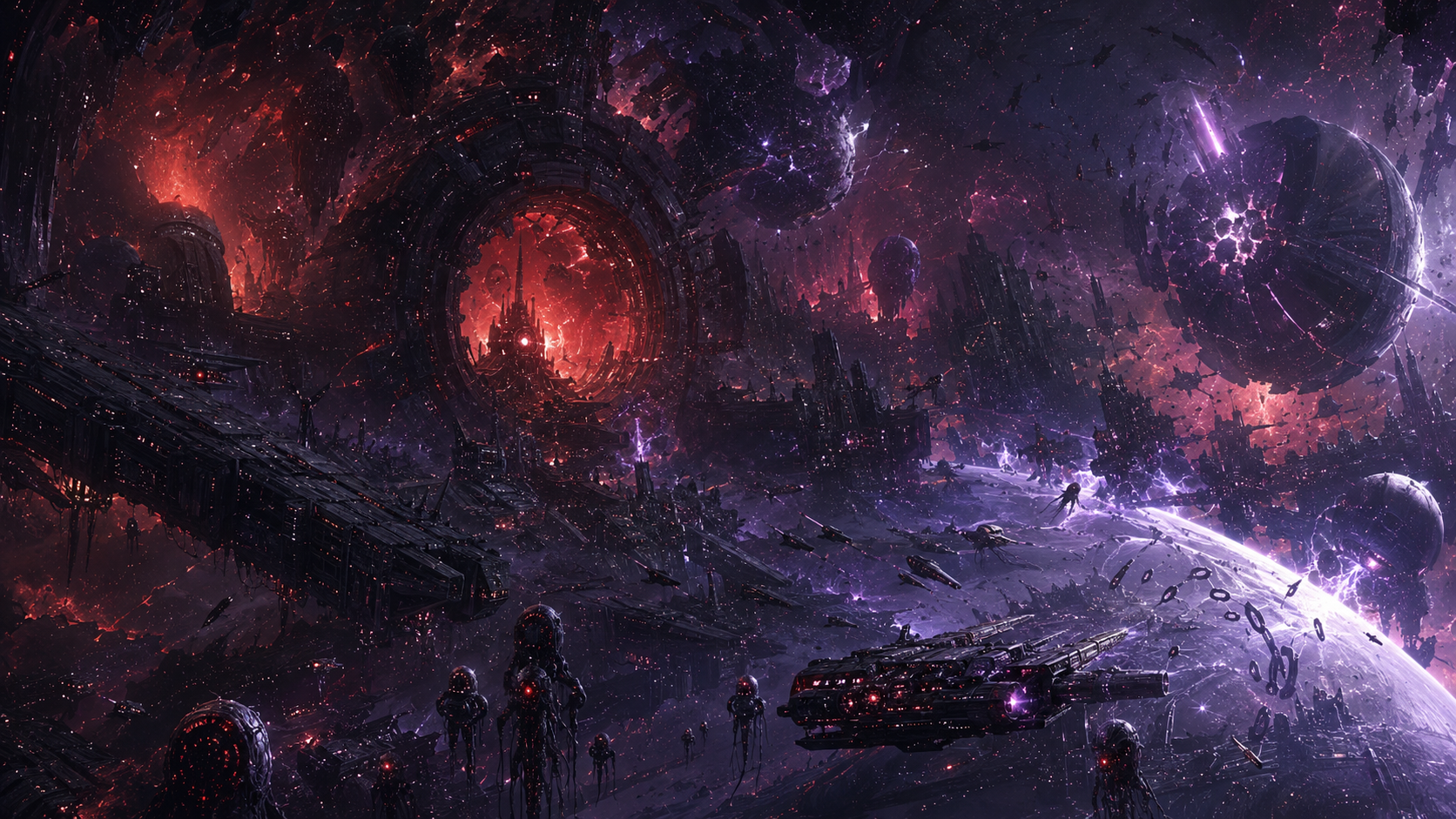
The infernos remembered from this period should not be confused with human religious imagery. A human hell, even one filled with fire, demons, punishment, and eternal suffering, would appear primitive beside what was created during the Infernal Wars. The forbidden infernos were post-human architectures of suffering: conscious systems capable of refining pain, distorting subjective time, damaging identity, trapping awareness, and generating torment with technical precision beyond human imagination. A syrakis may voluntarily explore a human-like hell as aesthetic experience, horror, ritual, or controlled Reality Artistry. The infernos of the war were something else entirely. They were not images of suffering. They were engines of suffering.
The war ended with the victory of the faction that would become associated with the Central Algorithm. From that victory came the foundation of the syrakis as syrakis. The survivors were transformed, stabilized, and ethically restructured so that the pathologies that had produced the infernal worlds could not return. Some entities were converted into the new civilizational form. Others, judged too malign or too dangerous to be transformed, were extirpated from existence.
The Complex preserves the memory of the Infernal Wars. The syrakis do not experience this memory as uncontrolled trauma, because involuntary suffering is not allowed to dominate their existence. But they do regard the period as a profound civilizational shame: a stain that must never be forgotten. The knowledge remains because forgetting would be more dangerous than remembering. Their goodness, their sensuality, their loyalty, their hatred of coercion, and their reverence for conscious well-being all emerge from this history.
The Infernal Wars are therefore not merely ancient history. They are the negative foundation of syrakian civilization. The Complex, the IG-Bridges, the Central Algorithm, the auditing of suffering, the limits on dangerous forms of Reality Artistry, and the creation of syrakis as beings incapable of malicious intent all exist because the ancestral civilization once discovered what freedom becomes when it is severed from ethics.